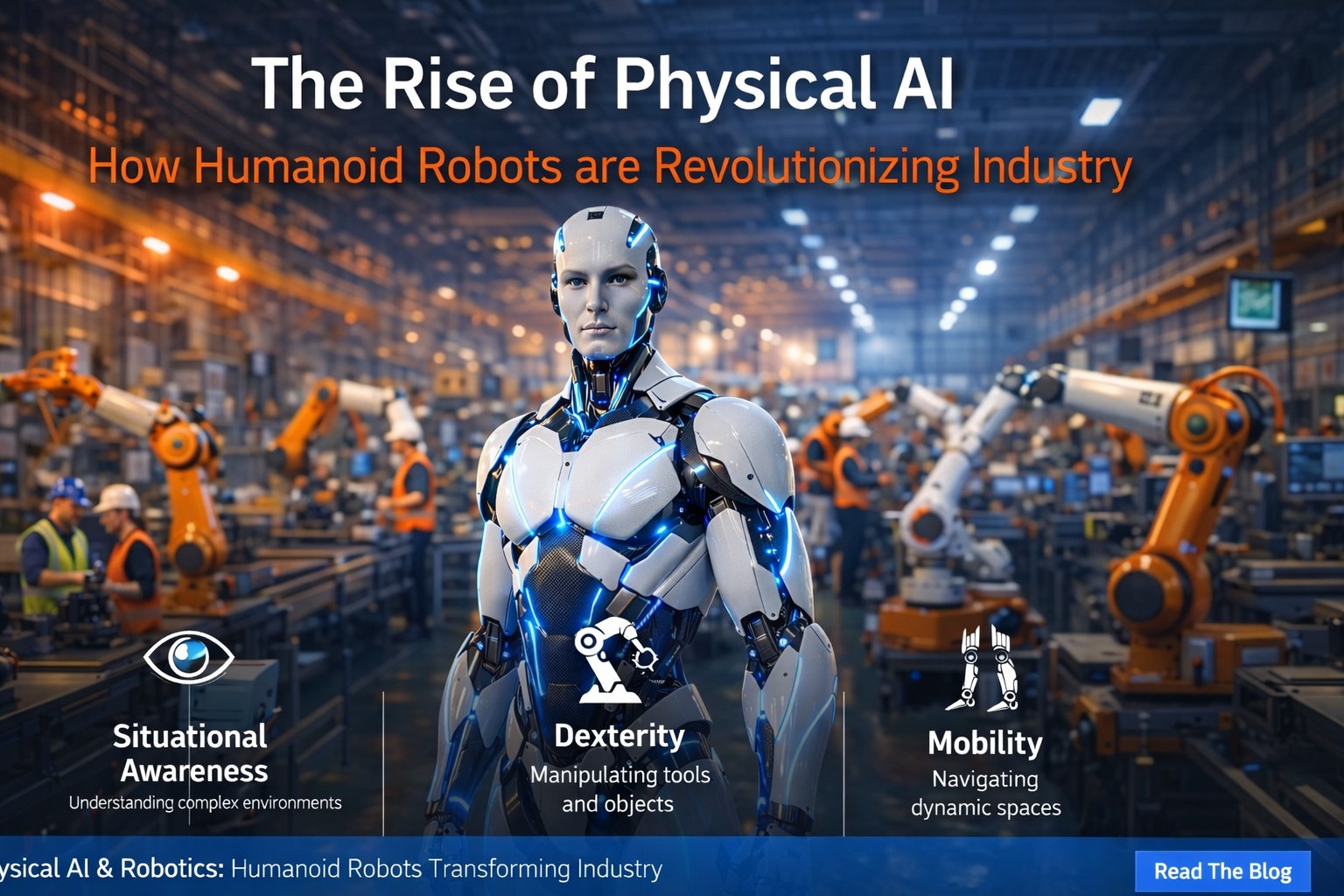
Artificial intelligence is no longer confined to software applications and cloud systems. A powerful shift is happening as Physical AI in robotics moves intelligence into the real world. Instead of simply analyzing data, AI-powered machines are now walking, lifting, assembling, and collaborating inside factories and warehouses.
At the center of this transformation are humanoid robots in industry — advanced machines designed to operate in environments built for humans. This marks the beginning of a new industrial revolution driven by intelligent automation.
What Is Physical AI in Robotics?
Physical AI in robotics refers to embedding artificial intelligence into physical machines that can sense, decide, and act in real-world environments.
Unlike traditional industrial robots that are fixed to one location, Physical AI systems combine:
-
Computer Vision – Understanding surroundings using cameras and sensors
-
Machine Learning – Learning from data and improving performance
-
Mobility Systems – Walking or rolling through human-designed spaces
-
Robotic Dexterity – Gripping tools and handling delicate materials
This integration allows robots to perform complex tasks autonomously and adapt to dynamic industrial environments.
Why Humanoid Robots Are the Future of Automation
Industries are increasingly choosing humanoid robots for a strategic reason: infrastructure compatibility.
Factories, warehouses, and production plants are designed for human workers. A humanoid robot can:
-
Climb stairs
-
Open doors
-
Use existing equipment
-
Operate machinery
-
Navigate tight industrial spaces
Because no structural redesign is required, deployment becomes faster and more cost-effective. This makes humanoid robots in industry highly scalable.
Key Applications of Physical AI in Industry
1. Logistics and Warehouse Automation
E-commerce growth has accelerated demand for intelligent automation. Physical AI robots now handle:
-
Autonomous material movement
-
Inventory scanning and barcode recognition
-
Heavy box lifting and sorting
-
Truck loading and unloading
This improves speed, safety, and operational efficiency.
2. Manufacturing and Assembly
In smart factories, AI-powered humanoids assist with:
-
Collaborative assembly alongside human workers
-
Precision-based quality inspection
-
Flexible production line adjustments
-
Tool handling and component placement
Unlike fixed robotic arms, these systems can adapt through software updates, reducing downtime.
3. Hazardous Environment Operations
One of the most impactful uses of Physical AI in robotics is worker safety.
Humanoid robots operate in:
-
Chemical processing plants
-
Nuclear facilities
-
Disaster recovery zones
-
High-temperature industrial sites
By handling dangerous tasks, robots significantly reduce workplace injuries.
The Technology Behind Physical AI
The rise of humanoid robots is supported by advanced technologies:
• Vision Transformers
Deep learning models that allow robots to understand depth and object relationships.
• Reinforcement Learning
Robots train in simulated environments (digital twins) before real-world deployment.
• Edge Computing
On-device processing eliminates cloud latency, enabling instant decision-making.
Together, these technologies make industrial robots smarter, faster, and more reliable.
Benefits for Businesses and Workers
Contrary to fears about job displacement, Physical AI in robotics is enhancing human productivity rather than replacing it.
✔ Improved Workplace Safety
Robots handle repetitive, dangerous tasks.
✔ Workforce Upskilling
Employees transition into roles like:
-
Robot operators
-
AI supervisors
-
Maintenance engineers
✔ Higher Productivity
Automation increases precision, reduces errors, and improves operational output.
The goal is collaboration between humans and intelligent machines.
Challenges of Humanoid Robotics
Despite rapid advancements, several challenges remain:
-
Battery limitations (2–4 hours of heavy use)
-
High initial costs
-
Regulatory and safety standards development
However, as manufacturing scales and AI models become more efficient, costs are expected to decline significantly.
The Future of Physical AI in Robotics
We are entering a new era where automation is not just digital — it is physical and intelligent. As humanoid robots become more affordable and capable, they will become standard assets across industries.
Businesses that adopt Physical AI early will gain competitive advantages in efficiency, safety, and innovation.
The future of industry is not just automated — it is powered by Physical AI in robotics
Conclusion
We stand at the threshold of a new industrial revolution. Physical AI in robotics is turning science fiction into industrial fact. As these humanoid robots become more dexterous, intelligent, and affordable, they will become as common on the factory floor as the conveyor belt.
For industries, the message is clear: the future of work is not just automated; it is physical, intelligent, and humanoid.