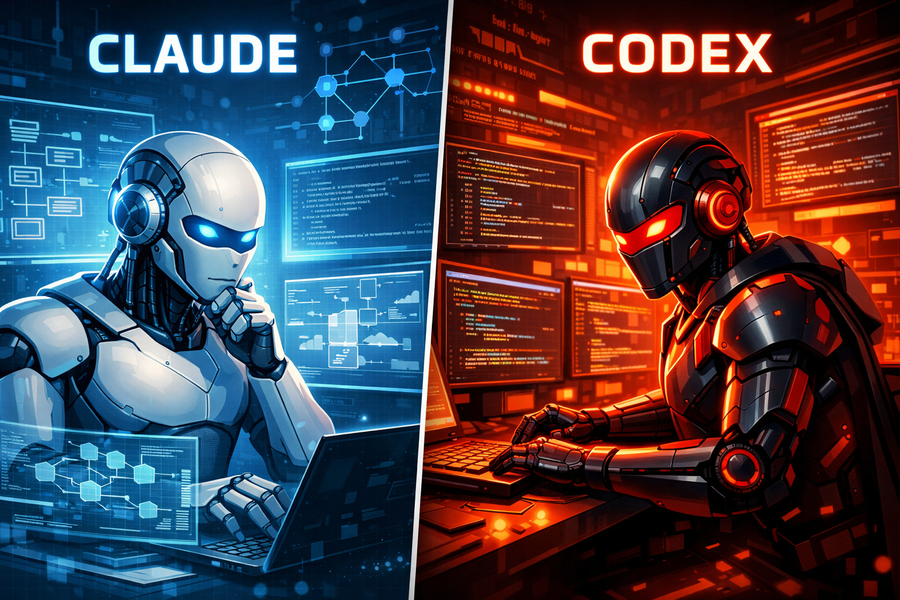
Claude vs Codex is one of the most important comparisons in today’s AI-driven development world. As artificial intelligence continues to transform how developers write, test, and deploy code, choosing the right AI coding assistant has become critical.
Both Claude and Codex are powerful tools, but they serve slightly different purposes. While one focuses on deep reasoning and understanding, the other emphasizes speed and automation. In this blog, we’ll explore the complete Claude vs Codex comparison to help you decide which tool is best for your workflow in 2026.
What is Claude?
Claude is an advanced AI model developed by Anthropic, designed for safe, reliable, and intelligent interactions. It is widely known for its strong reasoning capabilities and long context understanding.
Claude is especially useful for:
- Writing complex logic
- Understanding large codebases
- Explaining code step-by-step
- System architecture planning
With its ability to process large amounts of context, Claude acts like a senior software engineer, guiding developers through complex decisions.
What is Codex?
Codex is an AI coding model developed by OpenAI, built to automate software development tasks at scale.
Codex is known for:
- Fast code generation
- Automated debugging
- Writing full applications
- Running tests and fixing errors
Codex behaves like a high-speed coding assistant, capable of executing tasks quickly with minimal human input.
Claude vs Codex: Key Differences
1. Approach to Coding
The biggest difference in Claude vs Codex lies in their approach:
- Claude: Focuses on understanding, reasoning, and planning
- Codex: Focuses on execution, automation, and speed
Claude helps you think before coding, while Codex helps you build faster.
2. Performance and Speed
When it comes to speed:
- Codex generates code much faster
- It can complete tasks almost instantly
- Ideal for rapid development and tight deadlines
Claude, while slightly slower, produces:
- More thoughtful and structured code
- Better handling of complex scenarios
👉 Verdict: Codex wins in speed, Claude wins in depth.
3. Reasoning and Intelligence
Claude is widely considered superior in reasoning:
- Better understanding of complex problems
- Strong logical thinking
- More accurate explanations
Codex is good at:
- Practical coding
- Execution of defined tasks
👉 Verdict: Claude is better for problem-solving and learning.
4. Debugging and Error Handling
Codex excels in:
- Finding bugs quickly
- Suggesting fixes instantly
- Running automated tests
Claude is better at:
- Explaining why the bug happened
- Teaching debugging concepts
👉 Verdict: Codex = faster fixes, Claude = deeper understanding.
5. Developer Experience
The developer experience is very different:
- Claude: Interactive and conversational
- Codex: Automated and task-driven
Claude feels like collaborating with a mentor, while Codex feels like assigning work to a tool.
6. Context Handling
Claude supports very large context windows, which means:
- Better for large projects
- Can analyze multiple files together
- Ideal for enterprise-level applications
Codex is efficient but may not handle extremely large context as deeply.
👉 Verdict: Claude wins for large-scale development.
7. Cost and Efficiency
- Codex is generally more cost-efficient due to faster outputs
- Claude may use more tokens but provides deeper insights
👉 Choose based on your needs:
- Budget → Codex
- Quality → Claude
Real-World Use Cases
When to Use Claude
- Complex backend systems
- Architecture design
- Learning and mentoring
- Code reviews and explanations
When to Use Codex
- Building features quickly
- Automating repetitive tasks
- Debugging and testing
- CI/CD workflows
Hybrid Workflow: Best of Both Worlds
In 2026, many developers are combining both tools:
- Use Claude for planning and decision-making
- Use Codex for execution and deployment
This hybrid approach maximizes:
- Productivity
- Accuracy
- Speed
Future of AI Coding Tools
The competition between Anthropic and OpenAI is pushing innovation rapidly.
Future trends include:
- Fully autonomous AI developers
- Integration with IDEs and DevOps tools
- AI handling entire software lifecycles
AI coding assistants are no longer optional—they are becoming essential tools for every developer.