
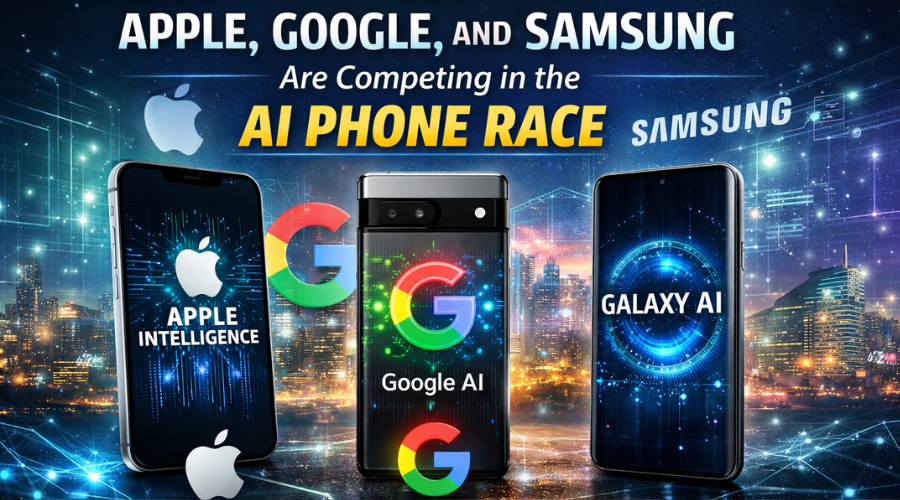
Artificial Intelligence is becoming the most important battleground in the smartphone industry. In 2026, the AI Phone Race is mainly led by three tech giants: Apple, Google, and Samsung. These companies are investing heavily in AI to transform smartphones into intelligent personal assistants capable of understanding users, predicting their needs, and automating daily tasks.
From smarter cameras and real-time translation to on-device AI assistants, smartphones are evolving rapidly. Instead of relying entirely on cloud processing, modern phones are increasingly performing AI tasks directly on the device, making them faster, more secure, and more efficient.
Let’s explore how Apple, Google, and Samsung are competing to dominate the AI-powered smartphone future.
Apple’s Strategy: Privacy-Focused AI and Apple Intelligence
Apple entered the AI race slightly later than its competitors but quickly made a strong impact with Apple Intelligence, introduced in its recent iPhone lineup.
Apple’s approach focuses heavily on privacy and on-device AI processing. Instead of sending large amounts of data to the cloud, Apple processes many AI tasks directly on the device using its powerful custom chips.
Key AI Features from Apple
Smart Writing Tools: AI helps users rewrite, summarize, and edit messages and emails.
Advanced Siri: A more conversational and context-aware voice assistant.
AI Photo Editing: Automatic object removal, enhancement, and organization.
Private Cloud Compute: Secure cloud processing when local processing isn’t enough.
Apple integrates AI deeply into iOS rather than launching it as a separate feature. This creates a seamless experience across apps like Messages, Mail, Photos, and Notes.
Apple’s powerful A-series chips and Neural Engine are also optimized for running AI models efficiently on-device, giving Apple a strong hardware advantage.
Google’s Strategy: AI-First Smartphones
Google has always been an AI-first company, and its Pixel smartphones reflect that philosophy. With the integration of advanced AI models like Gemini, Google is pushing the boundaries of what smartphones can do.
Google focuses on using AI to make smartphones more helpful, proactive, and intelligent.
Key AI Features from Google
AI Call Screening: Automatically handles spam calls.
Magic Editor in Photos: Advanced AI editing tools that can move or modify objects in images.
Live Translation: Real-time translation during calls and conversations.
AI Assistant with Context Awareness: Google Assistant understands user habits and context better.
Google’s advantage lies in its massive AI research infrastructure and data expertise, allowing it to introduce cutting-edge features faster than competitors.
Pixel devices often act as a testing ground for new AI technologies before they spread to the broader Android ecosystem.
Samsung’s Strategy: Galaxy AI for Mass Adoption
Samsung is taking a slightly different approach by focusing on bringing AI features to millions of users globally through its Galaxy smartphone lineup.
With Galaxy AI, Samsung combines both on-device AI and cloud-based AI services to deliver powerful features across its flagship phones.
Key AI Features from Samsung
Live Translate: Real-time translation during phone calls.
AI Photo Editing: Advanced image enhancement and object removal.
Note Assist: AI-generated summaries for notes.
Circle to Search: Instantly search anything on the screen.
Samsung benefits from its strong global smartphone market share, allowing AI features to reach a much larger audience compared to competitors.
Additionally, Samsung collaborates closely with Google, integrating many of Google’s AI capabilities directly into Galaxy devices.
The Role of On-Device AI
One major trend driving the AI Phone Race is the shift toward on-device AI processing.
Benefits of on-device AI include:
Faster response times
Better privacy protection
Reduced internet dependency
Improved battery efficiency
Modern smartphone chips now include Neural Processing Units (NPUs) specifically designed to run AI models efficiently.
This hardware evolution is enabling features like:
Real-time voice translation
Smart photo editing
AI assistants with deeper personalization
Advanced video processing
Who Is Winning the AI Phone Race?
Currently, each company has its own strengths in the AI smartphone competition:
Apple
Best integration of AI with privacy
Strong hardware optimization
Most advanced AI models and research
Innovative AI features first
Samsung
Largest global reach
Fast adoption of AI features across devices
Rather than a single winner, the competition is pushing all three companies to innovate faster.
The Future of AI Smartphones
The AI Phone Race is just beginning. Over the next few years, smartphones are expected to become even more intelligent.
Future AI features may include:
Fully conversational AI assistants
Automatic task execution across apps
AI-powered health monitoring
Personalized user interfaces
Real-time video generation and editing
Eventually, smartphones may function as true digital companions, understanding users’ habits, preferences, and needs.
Conclusion
The competition between Apple, Google, and Samsung is driving one of the most exciting technological revolutions in smartphones: the rise of AI-powered devices.
Each company brings a unique approach—Apple focuses on privacy and seamless integration, Google leads in AI innovation, and Samsung aims for large-scale adoption.
As the AI Phone Race intensifies, users will benefit from smarter, faster, and more personalized smartphones than ever before.


