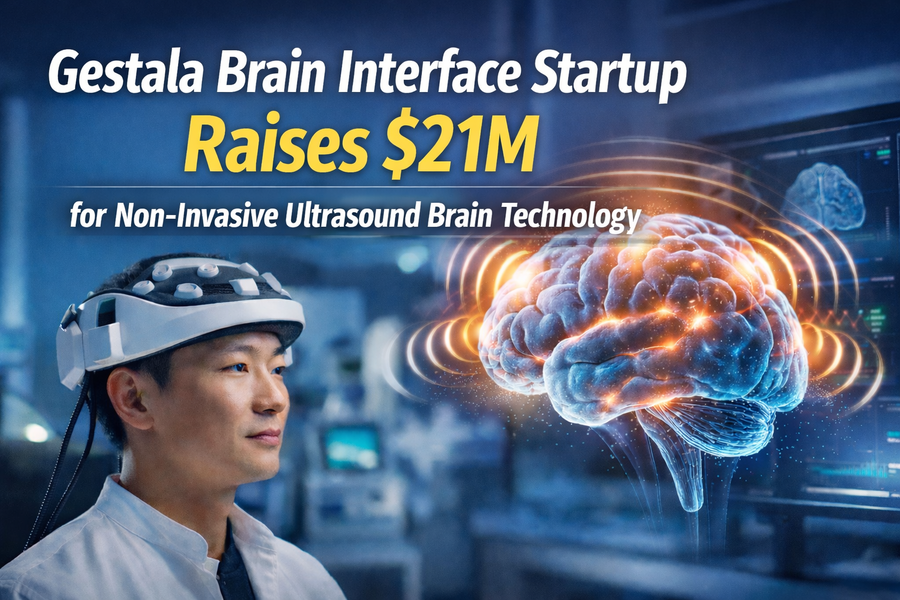
The Gestala brain interface startup has captured global attention after raising $21 million in funding just two months after launch. The Chinese neurotechnology company is developing a non-invasive brain-computer interface (BCI) powered by ultrasound technology, which could allow computers to communicate with the human brain without surgical implants.
Brain-computer interfaces are rapidly becoming one of the most exciting areas in modern neuroscience and healthcare innovation. Companies worldwide are racing to develop systems that can interpret brain signals, treat neurological diseases, and enable direct communication between humans and machines.
With its ultrasound-based brain interface technology, Gestala is positioning itself as a major competitor in the global BCI industry.
What Is the Gestala Brain Interface Startup?
The Gestala brain interface startup is a Chinese neurotechnology company focused on developing non-invasive ultrasound brain-computer interfaces.
Unlike traditional BCI systems that require electrodes implanted inside the brain, Gestala’s technology uses focused ultrasound waves to interact with neural circuits.
This innovative approach could allow researchers and doctors to:
-
Monitor brain activity
-
Stimulate specific brain regions
-
Communicate with neural networks
All of these processes could potentially occur without brain surgery, which dramatically reduces medical risks.
Because of this advantage, non-invasive BCIs are widely considered the next generation of neurotechnology.
Gestala Raises $21 Million in Funding
The Gestala brain interface startup raised $21 million (approximately ¥150 million) in a recent funding round supported by venture capital firms and technology investors.
According to reports, the funding round was oversubscribed, meaning investor demand exceeded the company’s initial funding target.
This strong investor interest highlights the rapid growth of the brain-computer interface market.
Despite launching only two months ago, the company has already reached an estimated valuation between $100 million and $200 million, an impressive milestone for a new startup in the neurotechnology industry.
How Gestala’s Ultrasound Brain Technology Works
The company’s technology is based on focused ultrasound neuromodulation, a method that allows scientists to influence brain activity using sound waves.
Instead of implants, the system sends precisely controlled ultrasound signals into brain tissue, allowing interaction with neurons deep inside the brain.
Advantages of Ultrasound Brain Interfaces
1. Non-Invasive Technology
The biggest advantage is that the system does not require brain surgery, reducing health risks.
2. Deeper Brain Access
Ultrasound waves can reach deep brain structures that many non-invasive technologies cannot access.
3. High Precision
Focused ultrasound allows scientists to target specific brain regions with high accuracy.
Because of these benefits, many experts believe ultrasound BCIs could become a breakthrough technology in neuroscience.
Medical Applications of Brain-Computer Interfaces
The Gestala brain interface startup is initially focusing on healthcare applications, where brain-computer interfaces could transform the treatment of neurological disorders.
Potential medical uses include:
-
Chronic pain treatment
-
Depression therapy
-
Parkinson’s disease management
-
Stroke rehabilitation
-
Autism research
-
Alzheimer’s disease treatment
-
PTSD therapy
One of the company’s early research targets is chronic pain treatment, where ultrasound stimulation may help regulate pain signals inside the brain.
If successful, this technology could help millions of patients worldwide.
China’s Rapid Growth in Brain-Computer Interface Technology
China has become one of the fastest-growing centers for brain-computer interface innovation.
The country is investing heavily in neuroscience, artificial intelligence, and biotech startups.
Several factors are driving this growth:
-
Strong government support for advanced technologies
-
Rapidly expanding biotech startup ecosystem
-
Access to large clinical trial networks
-
Lower research and development costs
Experts believe China could become a global leader in BCI technology within the next decade.
The rise of the Gestala brain interface startup reflects how quickly the neurotechnology industry is expanding.
Competition in the Brain-Computer Interface Market
The brain-computer interface industry is becoming increasingly competitive.
Some well-known companies working in this field include:
-
Neuralink
-
Synchron
-
Paradromics
While many of these companies focus on implantable brain chips, Gestala is developing a non-invasive ultrasound approach.
This could offer a safer and more scalable alternative if clinical trials prove successful.
What’s Next for the Gestala Brain Interface Startup?
With fresh funding secured, the Gestala brain interface startup plans to accelerate development of its ultrasound BCI technology.
The company’s next steps include:
-
Expanding engineering and research teams
-
Developing early BCI prototypes
-
Conducting clinical trials
-
Partnering with hospitals and research institutions
Gestala also plans to build a large brain-signal database that can help train artificial intelligence models to interpret neural activity.
The Future of Brain-Computer Interfaces
Brain-computer interfaces are expected to become one of the most transformative technologies of the next decade.
They could revolutionize:
-
Healthcare
-
Human-computer interaction
-
Artificial intelligence
-
Rehabilitation medicine
The rapid rise of the Gestala brain interface startup shows how fast the neurotechnology sector is evolving.
If ultrasound-based brain interfaces become widely adopted, they could make brain technology safer, cheaper, and accessible to millions of people worldwide.