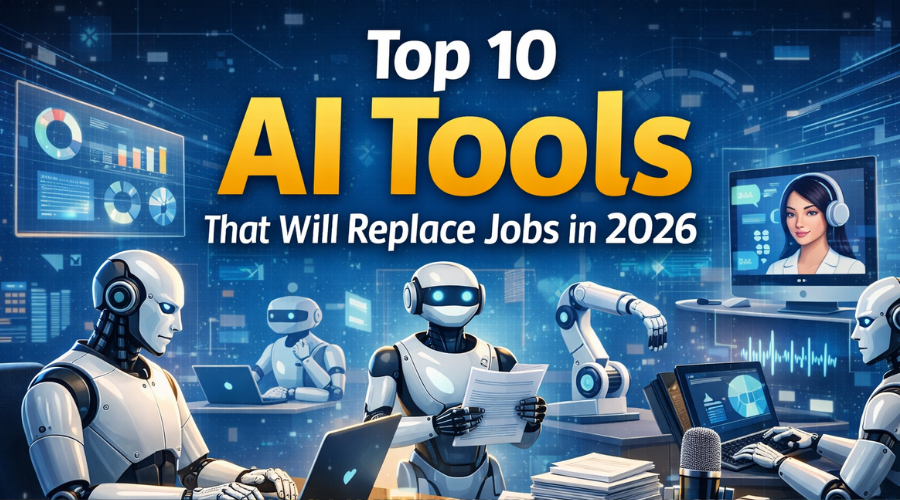
Artificial Intelligence is transforming the global workforce at an unprecedented pace. In 2026, AI tools are not just assisting humans—they are increasingly automating tasks that were once done entirely by people. From writing content to designing graphics and analyzing data, AI-powered tools are changing how businesses operate.
While AI will create new opportunities, it is also replacing many repetitive or routine jobs. Companies are adopting AI tools to increase productivity, reduce costs, and improve efficiency.
In this article, we explore the Top 10 AI Tools That Will Replace Jobs in 2026 and how they are shaping the future of work.
1. ChatGPT – AI for Content Creation and Customer Support
AI writing tools have dramatically improved in recent years, and ChatGPT is leading the revolution. Businesses now use AI for:
-
Blog writing
-
Customer support chats
-
Email responses
-
Coding assistance
Many companies are replacing basic content writers and support agents with AI chatbots that can respond instantly to thousands of users simultaneously.
Jobs affected
-
Customer support agents
-
Entry-level content writers
-
Basic copywriters
2. Midjourney – AI Graphic Design
AI image generation tools like Midjourney allow users to create professional graphics simply by typing a prompt.
Businesses can generate:
-
Social media graphics
-
Marketing images
-
Concept art
-
Advertising visuals
This reduces the need for designers for simple design tasks.
Jobs affected
-
Junior graphic designers
-
Stock image creators
3. GitHub Copilot – AI Coding Assistant
AI is now helping developers write code faster. GitHub Copilot can generate entire code snippets, debug errors, and even suggest full functions.
Many startups are using AI coding assistants to speed up development with smaller teams.
Jobs affected
-
Junior developers
-
Manual code testers
4. Jasper AI – AI Marketing Content
Jasper AI is widely used for creating marketing content, product descriptions, and advertising copy.
Marketing teams can now generate high-quality copy within seconds.
Jobs affected
-
Copywriters
-
Marketing content creators
5. Synthesia – AI Video Creation
Video creation once required cameras, actors, and editing teams. With Synthesia, companies can create professional videos using AI avatars and voiceovers.
Businesses use it for:
-
Training videos
-
Product demos
-
Educational content
Jobs affected
-
Video presenters
-
Basic video editors
6. Runway AI – AI Video Editing
Runway AI is changing video production by automating editing tasks like background removal, effects, and scene generation.
Creators can produce cinematic content without advanced editing skills.
Jobs affected
-
Entry-level video editors
-
Basic VFX artists
7. AutoGPT – Autonomous AI Agents
Autonomous AI agents like AutoGPT can perform complex tasks without constant human supervision.
These AI systems can:
-
Conduct research
-
Write reports
-
Execute workflows
Jobs affected
-
Research assistants
-
Administrative analysts
8. Notion AI – AI Productivity Assistant
Productivity tools now integrate AI features to automate documentation, summarization, and task planning.
Notion AI can generate meeting summaries, create reports, and organize projects automatically.
Jobs affected
-
Administrative assistants
-
Data entry staff
9. Pictory AI – AI Video From Text
Pictory AI converts blog posts or scripts into professional videos automatically.
This is widely used by content creators and marketers who want quick video content without editing software.
Jobs affected
-
Basic video editors
-
Social media content creators
10. ElevenLabs – AI Voice Generation
Voice AI tools like ElevenLabs generate highly realistic voices that sound almost human.
Companies are using AI voices for:
-
Audiobooks
-
YouTube narration
-
Customer support bots
Jobs affected
-
Voice-over artists
-
Narrators
Will AI Replace All Jobs?
Although AI tools are replacing certain roles, they are also creating new job opportunities. The future workforce will likely focus more on:
-
AI management
-
Prompt engineering
-
AI system training
-
Creative strategy roles
Instead of replacing humans completely, AI will most likely augment human productivity.
Workers who adapt to AI technologies will have a significant advantage in the future job market.
The Future of Work in the AI Era
By 2026, AI will become a normal part of everyday work. Companies that adopt AI tools early will gain a competitive advantage, while employees who learn to work alongside AI will remain valuable.
The key to surviving the AI revolution is continuous learning and skill development.
Rather than fearing AI, professionals should focus on learning how to use AI tools effectively to enhance their careers.