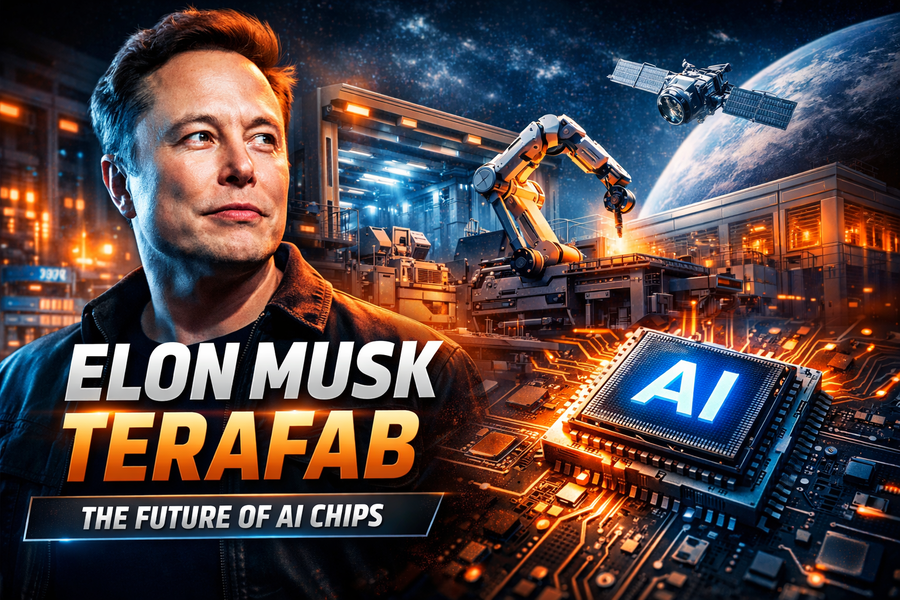
Elon Musk Terafab is one of the most ambitious technology projects announced in 2026, aiming to redefine how artificial intelligence infrastructure is built. Spearheaded by Elon Musk, this initiative focuses on solving one of AI’s biggest challenges: the shortage of high-performance computing power.
As AI models from companies like OpenAI and Google become more advanced, the demand for powerful chips has skyrocketed. Elon Musk Terafab is designed to meet this demand at an unprecedented scale.
🔧 What is Elon Musk Terafab?
Elon Musk Terafab is a large-scale semiconductor manufacturing project focused on producing next-generation AI chips. It is expected to support Musk’s companies, including Tesla and SpaceX.
Key Features:
- Massive AI chip fabrication facility
- Designed for AI, robotics, and autonomous systems
- High-efficiency, high-performance chip production
- Long-term goal: terawatt-level compute output
Unlike traditional fabs, Elon Musk Terafab aims to produce chips specifically optimized for AI workloads, making it a critical piece of future technology infrastructure.
⚡ Why Elon Musk Terafab Matters
The importance of Elon Musk Terafab lies in its ability to address the growing gap between AI innovation and hardware availability.
Currently, most companies depend on:
- NVIDIA
- TSMC
This dependency leads to:
- Limited supply
- High costs
- Slower AI development
Musk’s Vision:
With Elon Musk Terafab, the goal is to:
- Control chip production
- Reduce dependency on third parties
- Scale AI faster than competitors
🤖 Applications of Elon Musk Terafab
🚗 Autonomous Driving
Tesla will benefit from Elon Musk Terafab through improved AI chips for:
- Real-time decision-making
- Enhanced self-driving capabilities
🦾 Robotics
Elon Musk Terafab will power humanoid robots like Optimus by providing:
- Efficient AI processing
- Scalable hardware solutions
🚀 Space AI Infrastructure
With SpaceX, Elon Musk Terafab could enable:
- Space-based data centers
- Global AI processing networks
🧠 Elon Musk Terafab and the AI Power Shift
The AI industry is shifting from software-first to hardware-driven innovation.
Then:
- Focus on algorithms
Now:
- Focus on compute power
Elon Musk Terafab represents this shift, where controlling hardware becomes as important as developing intelligent AI models.
⚔️ Competition in the AI Race
While Elon Musk Terafab focuses on infrastructure, other companies are innovating in different areas:
- OpenAI → Autonomous AI systems
- Google → Custom AI chips and models
- Microsoft → Cloud AI platforms
👉 Elon Musk Terafab stands out by targeting the foundation layer of AI.
🌍 Challenges Facing Elon Musk Terafab
Despite its potential, Elon Musk Terafab must overcome:
💰 High Costs
Chip fabrication requires billions in investment.
🧪 Technical Barriers
Advanced semiconductor manufacturing is highly complex.
🌐 Global Competition
Many countries are investing heavily in chip production.
🔮 Future of Elon Musk Terafab
If successful, Elon Musk Terafab could:
- Transform global AI infrastructure
- Accelerate innovation in robotics and automation
- Reduce reliance on current chip leaders
- Enable next-generation AI breakthroughs
🧠 Final Thoughts
Elon Musk Terafab is not just a chip factory—it’s a bold step toward controlling the future of artificial intelligence. While companies like OpenAI focus on making AI smarter, Elon Musk Terafab ensures there is enough computing power to sustain that intelligence.
👉 In the coming years, the success of AI will depend on two things:
- Intelligence
- Infrastructure
And Elon Musk Terafab is set to dominate the second.